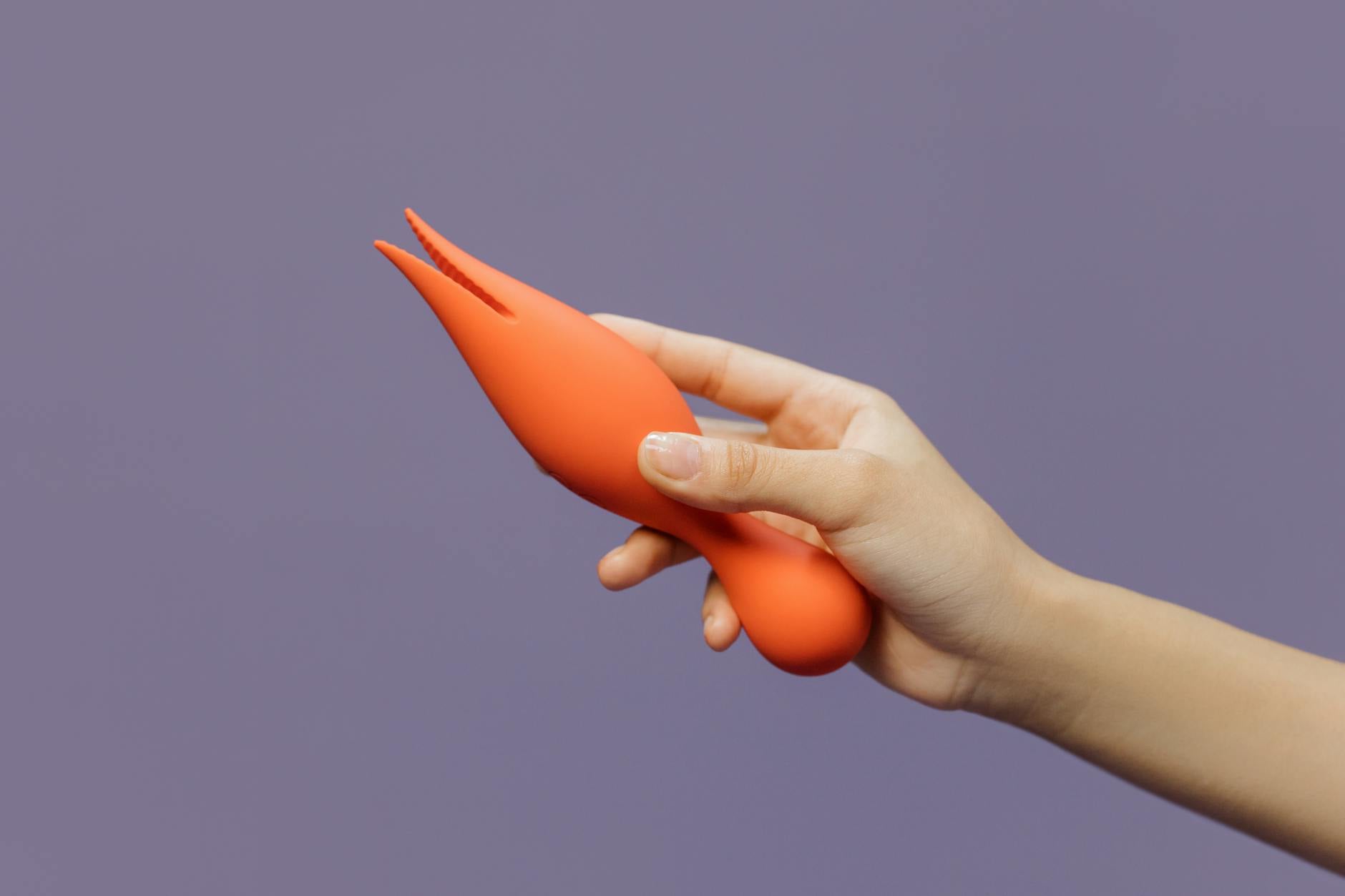
Here's the thing about relationship changes
When the rules shift, your body notices before your mind does. A new partner, the early stages of commitment, rejoining dating after years away, moving in together, even just shifting to a new dynamic with someone you've been with forever. These transitions come with an invisible audience in your head, and that audience is loud.
You're thinking about whether you're enough, whether you're responding the right way, whether they're noticing what you notice. That voice doesn't leave room for actual pleasure. And that's exactly where lemon vibrators come in.
Why performance anxiety kills sensation
Let's be clear about what's happening neurologically. When you're focused on how you look, whether you're taking too long, whether you're doing this right, your prefrontal cortex is running the show. Your prefrontal cortex is the part of your brain that evaluates, judges, and worries. It's useful for taxes and job interviews. It's terrible for orgasms.
For genuine pleasure, you need your brain to shift into the limbic system. That's where sensation actually registers. Performance anxiety keeps you locked in the prefrontal cortex, which means your body can send all the signals it wants. Your brain just isn't receiving them.
The research backs this up. A 2015 study in Sexual Medicine Reviews found that anxiety about sexual performance was directly correlated with diminished arousal in every gender. The more you're thinking about how you're performing, the less you actually feel.
Relationship transitions amplify this because the stakes feel higher. New partner means new eyes. Recommitting to an old partner after distance means proving you still want them. Moving in together means access without privacy. Your nervous system reads all of this as threat, and threatened nervous systems don't produce orgasms.
Why solo exploration is the reset button
Here's what changes when you use a lemon vibrator alone, without an audience (real or imagined). You take the performance pressure completely off the table. There's no one watching. There's no one timing you. There's no one silently wondering if you're into this.
That might sound simple, but it rewires something important. When you learn what your body actually likes when there's zero pressure, you build a reference point. You learn your own pleasure signature independent of someone else's presence or approval.
That knowledge doesn't disappear when your partner is in the room. It becomes the thing you're grounded in instead of the thing you're performing.
This is especially important after relationship changes because you're rebuilding a sense of safety in your own skin. When circumstances shift, ownership of your pleasure becomes the one stable thing.
Starting with a lemon sucker when everything feels watched
Lemon vibrators, particularly the suction-based style, are uniquely useful for this work because they don't require the same kind of deliberate positioning that vibrators with direct contact do. With a traditional vibrator, you're managing where it is, how much pressure, whether it's aligned right. That's still thinking. That's still performance.
A lemon clitoral vibrator uses gentle suction to stimulate without requiring precision. You can relax more. You can let your attention go inward instead of outward. That shift in attention is where the reset happens.
Start with this framework. Give yourself 15 minutes of complete privacy. Phone off. Door locked. No background noise that requires your attention. You're not trying to orgasm. You're not trying to achieve anything. You're just learning what feels good when there's zero pressure and zero judgment.
Set a low intensity. Most lemon vibrators have a range. Start at pattern 1 or 2. There's no prize for intensity. The whole point is to feel something that isn't connected to performance anxiety.
Rebuilding trust with your own responses
Relationship changes often come with questions about whether you can trust your body anymore. Did your response change? Are you still attracted? Did the dynamic shift something? That doubt creeps into your nervous system and stays there.
When you use lemon adult toys solo, you're building evidence that your body still works, that you can still feel, that your responses are real. That evidence is important. It's the counter-argument to the voice in your head saying something is broken.
After about a week or two of regular solo exploration, something shifts. You stop questioning whether sensation is possible. You start having opinions about what you actually want. That's the moment the performance pressure starts to loosen its grip.
Moving into partnership without losing yourself
Eventually, pleasure comes back into the picture with a partner. But if you've done this solo work first, the dynamic changes. You're not showing them your pleasure. You're not managing their response to your pleasure. You're inviting them into something you already know is real.
That's a fundamentally different energy. Your partner can feel the difference between someone performing and someone who's actually present. And presence is way more attractive than perfect execution.
Some people find that bringing a lemon vibrator into partnered sex becomes natural. Some people find that they rebuild sensation and intimacy without toys. Both are fine. The solo work is the thing that matters because it gives you the foundation.
When the pressure is about being "enough"
Honestly, relationship changes often trigger a specific anxiety. Am I enough without the novelty. Am I enough if the intensity changes. Am I enough if I'm not the person I was when they first met me.
Your body isn't the problem in that equation. The narrative is. And your body knows the difference between being touched because someone wants you and being touched while you're wondering if someone wants you.
Lemon vibrators can't change the narrative all by themselves. But they can give you proof that you still feel, that sensation is still available, that pleasure is still possible. That proof becomes louder than the doubt after a while.
Practical framework for using lemon vibrators through transitions
Week one: Solo exploration, low intensity, no expectations. You're learning baseline sensation. That's the entire goal.
Week two and three: Same framework, but you can start noticing what patterns feel best. You're building a map of your own pleasure.
Week four: If you're ready, you might introduce the idea to a partner or just feel into whether partnered sex feels different. You're not performing. You're checking in with yourself.
If any moment feels like you're checking in with your partner's response instead of your own sensation, step back. That's the performance anxiety sneaking back in. Reset to solo for a bit.
One thing that helps a lot of people is having a guide for choosing the right lemon vibrator for your body. It takes the guesswork out of equipment and lets you focus on sensation.
The framework works when you're honest
Relationship changes are a specific kind of vulnerability. You're reorganizing how you see yourself in relation to someone else. Your nervous system is watching carefully. Your body is checking whether it's safe to relax.
Lemon sexual toys give you a way to tell your body the answer is yes. Not eventually. Now. In this moment, with zero pressure, your pleasure matters and it's available.
That's the reset. Everything else builds from there.
People also ask
How long does it take to rebuild sensation after relationship changes?
Most people notice a shift within two to three weeks of consistent solo exploration. That doesn't mean sensation is fully back. It means you've interrupted the performance anxiety cycle enough to feel something real. Full integration usually takes four to eight weeks depending on how deep the anxiety runs and how much time you're dedicating to the work.
Can you use lemon vibrators with a partner right away after a relationship change?
You can, but I usually recommend solo exploration first. Here's why. If you bring a vibrator into partnered sex while you're still in performance anxiety, the vibrator becomes a tool for managing their experience instead of exploring yours. Solo exploration first, then partnership. The order matters.
What if using a lemon vibrator makes you feel more anxious?
That's a real response and it's worth listening to. Anxiety can come up if you're forcing yourself to relax when your nervous system isn't actually feeling safe. If that happens, step back. You might need to do some emotional processing before you're ready for this work. A therapist or counselor can help with that part.
Does using a vibrator alone mean there's something wrong with your partnership?
No. Solo pleasure and partnered pleasure are different experiences that use different parts of your nervous system. They both matter and they're not in competition. Building a strong sense of your own pleasure actually strengthens partnerships because you're showing up from a place of wholeness instead of need.
How do you move from solo exploration back to partnered sex without the anxiety returning?
Slowly. You're not trying to switch a light switch. You're building new neural pathways. Start by bringing a vibrator into partnered sex without focusing on the performance aspect. Focus on the sensation. If anxiety comes up, you can slow down or take a break. Your partner's job is to follow your pace, not to perform for them.
What if your partner feels threatened by lemon vibrators?
That's a separate conversation. Some partners worry that vibrators mean they're not enough. If that's happening, the vibrator isn't the actual issue. The issue is insecurity or a mismatch in how you're communicating about pleasure. A relationship coach or therapist can help you navigate that conversation in a way that doesn't abandon your own needs. Your pleasure matters just as much as theirs.
The bottom line
Relationship changes mess with your sense of permission. You start questioning whether it's safe to want things, whether you're allowed to take time for your own pleasure, whether your body is trustworthy. Solo exploration with a lemon vibrator gives you back the answer. Yes. Your pleasure is safe. Your body is trustworthy. You matter independently of someone else's presence.
That's not selfish. That's the ground everything else builds on.